
Co-ops & Social Ventures
Creating Opportunities: Social & Cooperative Entrepreneurship
The COVID-19 pandemic along with the disruptions of climate change, racial injustices, and wealth inequalities has made the cracks and fissures of our current economic system, capitalism, more evident than ever. A truly transformative economy that works for all needs to be rooted in solidarity if we want to center people and the planet over the maximization of profit.
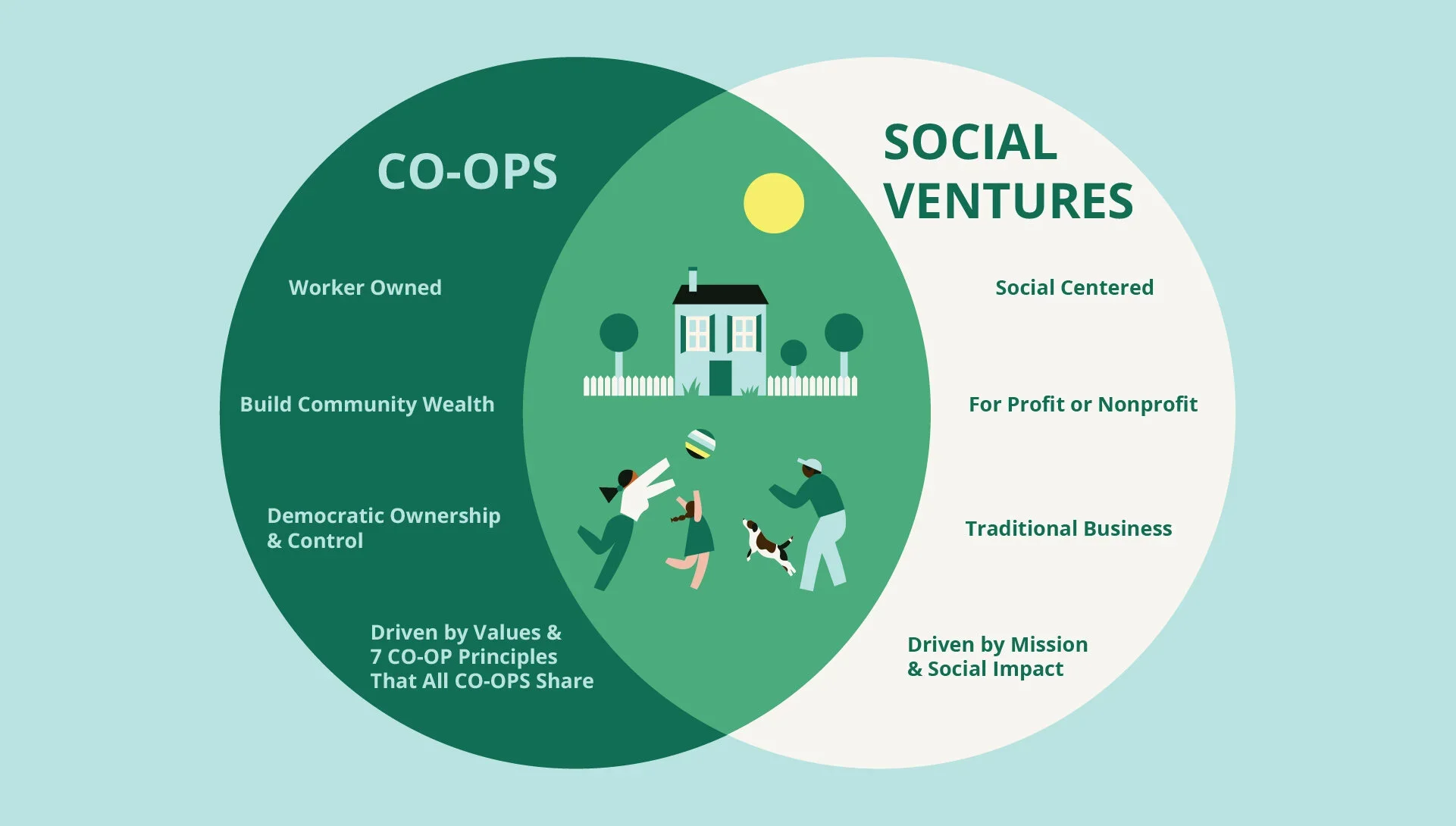
Worker cooperatives (or co-ops for short) and social ventures together are based on a triple bottom line of people, planet and profit. Worker co-ops, businesses owned and controlled by the people who work there, are one of the earliest and ultimate forms of social ventures. Worker co-ops have the additional aspects of democratic ownership and horizontal decision-making.
Worker Co-ops
Benny Overton, co-founder and co-director of the Southeast Center for Cooperative Development and member of the Collaborative Inquiry Team, shares his thoughts on worker cooperatives:
In examining the importance of cooperatives, I will begin by noting just what are cooperatives and what makes them unique. Cooperatives are “people-centered enterprises jointly owned and democratically controlled by and for their members to realize their common socio-economic needs and aspirations.” They are enterprises driven by values and principles that refute the notion that people are subordinate to capital and which give priority to creating fair and egalitarian organizations that are sustainable businesses providing stable jobs which share justly the fruits of the ventures.
Social Ventures
Ellen Peterson, executive director of Justice Industries, a nonprofit organization that creates social enterprise businesses, and member of the Collaborative Inquiry Team, shares her thoughts on social ventures:
Social enterprise has been a buzz word for quite some time but nailing down one definition can be difficult. Some will say they are mission-driven organizations, others define them as having a focus on social impact, while still more describe them as businesses with a positive environmental impact. The Social Enterprise Alliance defines social enterprise as “organizations that address a basic unmet need or solve a social or environmental problem through a market-driven approach.”
Justice Industies marked its 10th Anniversary this past year! Watch the short video below to learn more about this unique social venture in Nashville, TN.
Videos
Check out some short video clips on co-ops, churches, community, democracy, and economic solidarity.
Dr. Jessica Gordon Nembhard, Professor of Community Justice and Social Economic Development at the City University of New York, speaks on the church as the place to build economic solidarity.
Abrianni Perry, worker owner and Cooperation Jackson member, encourages the church to go beyond charity. (Worker Co-op and Conversion Conference December 2019, Nashville)
Ed Whitfield, Senior Fellow at Seed Commons, talks about worker cooperatives being schools of democracy rooted in community. (Worker Co-op and Conversion Conference December 2019, Nashville)
Worker Cooperative & Social Venture Examples
These worker cooperative examples from across the US were collected here to show that worker co-ops can be found in many different sectors of the economy, range in size (with the average size being 10 worker-owners), and support different populations (women, formerly incarcerated individuals, etc.). One of the best ways to learn more about the cooperative model is to research what is going on right now. For more information on worker cooperatives and a more complete listing go to the US Federation of Worker Cooperatives.
For more on union co-ops
A report by the Community and Worker Ownership Project at CUNY highlights the union tools used to bring impact and tells the stories of seven different cooperative business solutions using those tools. Through these examples we see how union power supports worker co-ops and how unions can deeply collaborate with the cooperative economy to build worker power to effectively own and control places of work for a more just, joyous and equitable world.



















Resources
We believe that worker cooperatives can be an approach to build power for economic structural change for churches and for the community at large.
Join us in exploring this concept by diving deeper into the resources we have collected below.